





Buy 3D Gold Scanner: Compare Features Before Order


When you plan to Buy 3D Gold Scanner equipment, choosing a device based only on an advertised depth number can lead to an unsuitable and expensive purchase. A professional 3D scanner should match your target type, soil conditions, search objective, experience level, and ability to interpret scan data.
These systems are commonly used to analyze underground areas for potential metals, cavities, tunnels, chambers, buried objects, and changes in soil structure. However, not every scanner uses the same sensors, software, scanning method, or visualization technology.
European Technology Group offers professional detection equipment, technical guidance, training, warranty options, and international delivery. Comparing the main features before ordering helps you select a practical system instead of paying for functions that do not support your fieldwork.
What Is a 3D Gold Scanner?
A 3D gold scanner is an advanced detection system that collects information from the ground and converts it into visual data. Depending on the device and technology, the results may appear as two-dimensional graphs, three-dimensional images, color-coded scans, or numerical measurements.
The term “3D” does not mean that the device produces a photographic image of an underground object. It usually means that the system processes multiple measurements to create a visual representation of underground anomalies.
These anomalies may indicate:
- Metallic objects.
- Ferrous or non-ferrous targets.
- Voids and cavities.
- Tunnels and chambers.
- Disturbed soil.
- Mineral concentrations.
- Changes in underground density.
The operator must analyze the target’s position, shape, signal strength, color pattern, and estimated depth. The accuracy of the interpretation depends on proper scanning, correct settings, soil conditions, software quality, and operator experience.
Buyers can compare professional 3D gold scanners to understand the available systems and identify which technology matches their search objectives.
Who Should Buy This Detector?
A 3D scanner is primarily suitable for users who need more information than a traditional audio signal can provide.
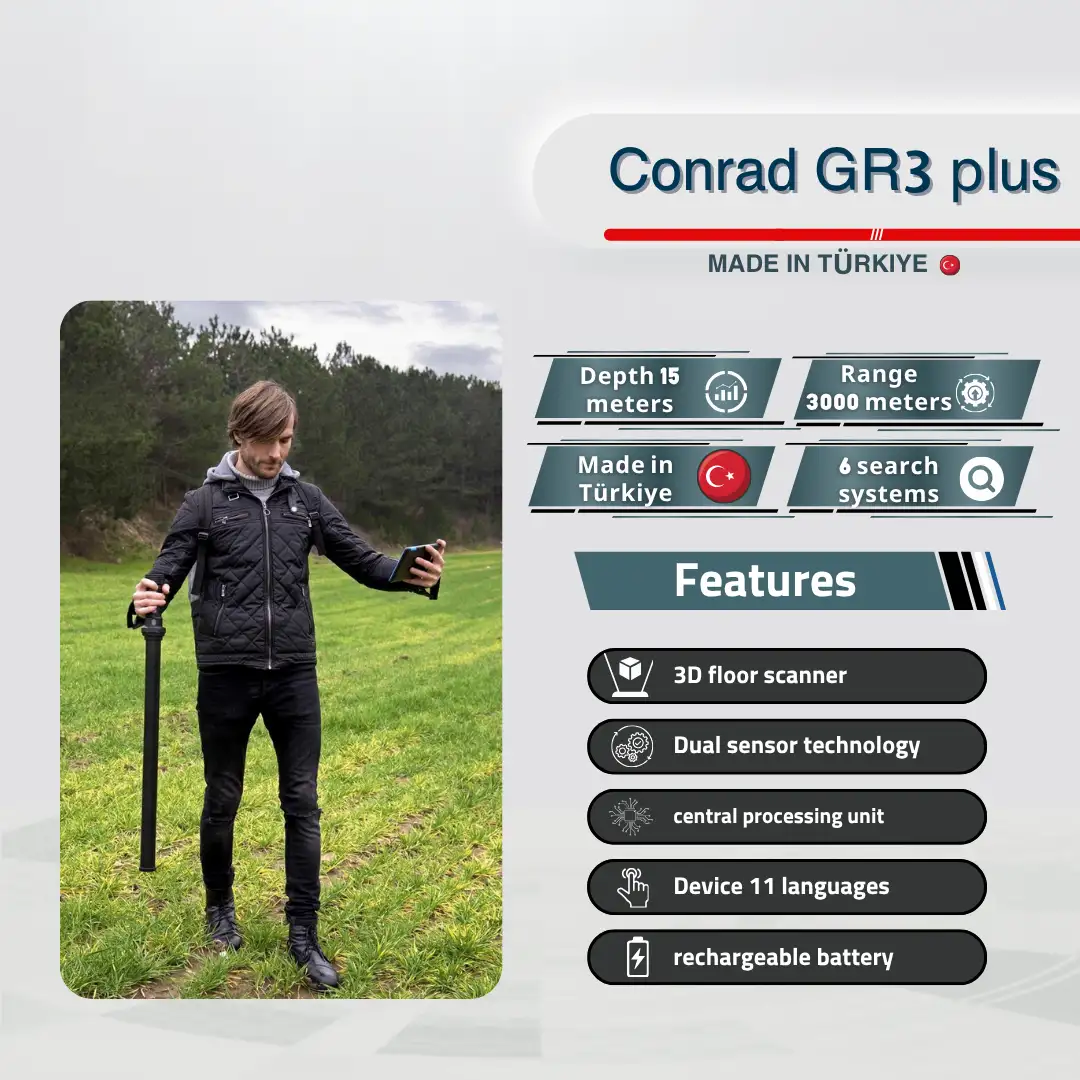
Conrad GR3 Plus 3D imaging ground scanner shown with key features for underground scanning, gold prospecting and buried target analysis.
Conventional metal detectors usually produce tones, target identification numbers, or simple visual indicators. A professional gold scanner can collect data from a wider underground area and allow the operator to review the results before deciding where to excavate.
This type of detector may be suitable for:
- Professional treasure hunters.
- Archaeological exploration teams.
- Users searching for large buried metal objects.
- Buyers investigating tunnels or underground rooms.
- Experienced detector operators.
- Land survey and preliminary exploration projects.
- Users who need saved scan files for later review.
- Search teams working across multiple locations.
A 3D scanner may not be the ideal first detector for a complete beginner. Scanning lines must usually be completed with consistent speed, direction, spacing, and sensor position. Incorrect movement can create misleading visual patterns.
Beginners who mainly want to search for shallow coins, jewelry, or small natural gold may find a simpler detector easier to operate. Reviewing different categories of Gold detectors can help determine whether a visual scanner or conventional detector is more suitable.
Before ordering, define whether you are searching for metal, cavities, natural gold, archaeological objects, or multiple target types. This decision will guide the selection process.
Main Technologies and Search Modes
Not every 3D metal scanner uses the same method to collect underground data. Some systems focus on magnetic changes, while others use pulse induction, electromagnetic measurements, ground probes, or multiple sensors.
The most common options include:
| Scanner technology | Typical use | Main consideration |
|---|---|---|
| Ground scanner | Detecting underground anomalies and large targets | Requires organized scanning and software interpretation |
| Magnetometer | Identifying ferrous metals and magnetic changes | May not respond equally to all non-ferrous targets |
| Pulse induction | Searching in mineralized soil and for large metal targets | Target discrimination may be limited |
| Electromagnetic scanner | Measuring changes in underground conductivity | Performance depends on soil and calibration |
| Multi-sensor system | Searching for metals, cavities, and structures | Usually requires more training |
| Live imaging system | Showing changes while the operator moves | Live results still require confirmation |
| Long-range locating mode | Preliminary scanning of wide areas | Should be verified using a direct detection system |
A professional imaging gold detector may contain several search modes. More modes can increase flexibility, but they can also make the device more complicated.
Common modes may include:
- Ground scan.
- Mineral scan.
- Magnetometer mode.
- Pinpoint mode.
- Live scan.
- Cavity detection.
- Deep target mode.
- Non-ferrous metal search.
- Ferrous metal identification.
- Long-range locating.
Buyers should not assume that a detector with the greatest number of modes is automatically the best. A specialized scanner with reliable data and clear software may provide greater value than a complex device with many systems that will rarely be used.
Ask the supplier to explain what each mode measures, what targets it is designed for, and whether it requires a particular sensor or accessory.
Depth Expectations and Soil Conditions
Detection depth is influenced by several connected factors. There is no fixed depth that applies to every target, terrain, and operator.
A large buried object normally produces a stronger underground response than a small coin or gold nugget. A chamber or tunnel may also appear differently from a metallic target because the scanner is detecting a change in ground structure rather than metal conductivity.
Important depth factors include:
| Depth factor | Effect on scanning performance |
|---|---|
| Target size | Large objects generally produce stronger and clearer anomalies |
| Target material | Ferrous and non-ferrous metals can produce different results |
| Target orientation | Horizontal and vertical targets may appear differently |
| Burial period | Long-buried objects may affect surrounding soil |
| Soil mineralization | Can create noise or confusing scan patterns |
| Ground moisture | May influence conductivity and signal stability |
| Scan spacing | Wide spacing may reduce image detail |
| Sensor height | Inconsistent height can create inaccurate data |
| Operator speed | Irregular movement can distort the scan |
| Software settings | Incorrect filters may hide or exaggerate anomalies |
Highly mineralized soil can make scanning more difficult. Natural minerals may appear as strong colors or unusual formations in the scan. The user must understand how to separate a real target from natural ground conditions.
Salt, wet soil, rocks, electrical interference, nearby metal, and uneven terrain can also affect performance. Before beginning a scan, remove metal objects from your clothing where possible and avoid working close to vehicles, fences, electrical cables, or large surface metals.
A trustworthy seller should ask about the expected target and ground conditions before recommending a device. Be cautious of guaranteed depth claims that do not mention target size, soil, technology, or test conditions.
Key Features to Compare Before Buying
When you Buy 3D Gold Scanner equipment, compare the complete detection and imaging system rather than selecting a device based on its exterior design.
Sensor Type
The sensor is one of the most important parts of the scanner. Some devices use a single telescopic sensor, while others use probes, coils, antennas, multi-sensor arrays, or separate scanning accessories.
Ask what the sensor detects and whether it can identify both metals and cavities.
Scan Resolution
Scan resolution determines how much information is collected from the search area. A detailed scan may help the operator examine the shape, location, and distribution of an underground anomaly.
Higher resolution alone does not guarantee an accurate result. Correct scan procedures and data processing are equally important.
3D Visualization
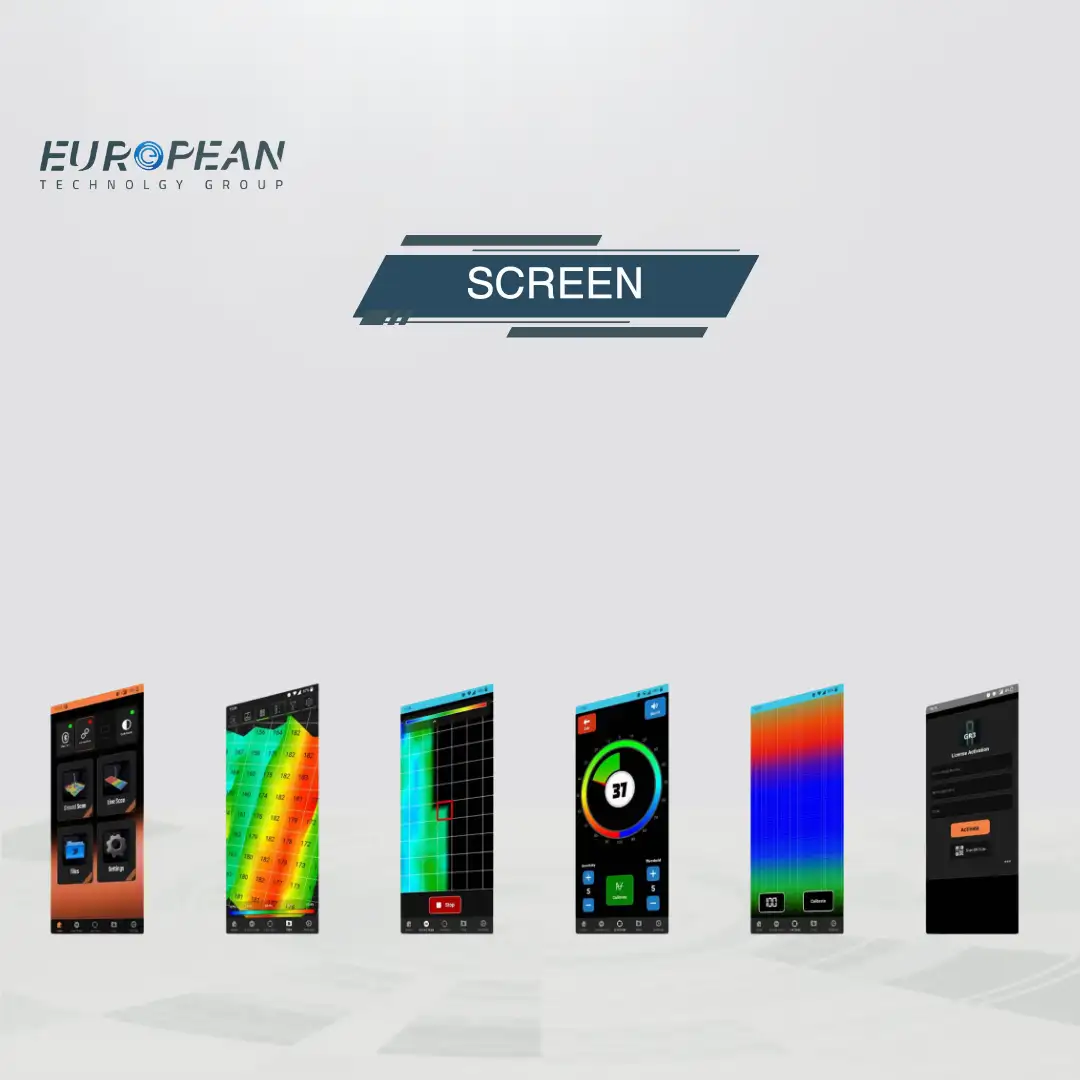
Conrad GR3 Plus screen display showing 3D ground scan imaging, underground visualization and target analysis.
The software should present underground data in a clear and understandable format. Common visualization features include:
- Color-coded target maps.
- Rotatable 3D images.
- Top and side views.
- Estimated depth measurements.
- Target position indicators.
- Signal strength values.
- Soil balance controls.
- Filtering and correction tools.
Data Storage
Professional users may need to save scans, compare several search areas, and review results later. Confirm whether the device can store scans internally or transfer them to a smartphone, tablet, or computer.
Target Identification
Some scanners attempt to distinguish between ferrous metals, non-ferrous metals, minerals, and cavities. Target identification should be treated as an interpretation aid rather than a guaranteed description of the buried object.
Ground Calibration
Calibration helps the scanner understand the normal conditions of the search area. Devices that offer ground adjustment or automatic soil calibration may provide more stable results in changing terrain.
Multilingual Interface
A clear menu in the operator’s preferred language can reduce setup errors. Confirm whether the device, application, software, and training materials support the required language.
Portability
Consider the detector’s total weight, sensor length, carrying case, battery system, and assembly time. A compact scanner may be preferable for mountainous areas, forests, or long search sessions.
Accessories, Coils, and Package Options
The accessories included with a 3D scanner can influence its search capabilities and overall purchase value.
Before paying, request a written list of every item included in the standard package. Do not assume that all sensors, software licenses, tablets, or headphones shown in promotional images are included.
A typical scanner package may contain:
- Main control unit.
- Scanning sensor or probe.
- Search coil.
- Tablet or smartphone.
- 3D visualization software.
- Wireless headphones.
- Rechargeable battery.
- Battery charger.
- International power adapters.
- Connection cables.
- Carrying case.
- User manual.
- Training materials.
- Warranty certificate.
- Software activation information.
Some packages may offer optional accessories such as:
- Larger deep-search coils.
- Small target coils.
- Cavity sensors.
- Long-range antennas.
- GPS systems.
- Additional batteries.
- Protective covers.
- External laptops or tablets.
Compare the package according to your search objective. A user focusing on underground chambers may need different sensors from a buyer searching primarily for metallic treasure targets.
Ask whether optional components can be added later and whether they require separate software, calibration, or training.
Warranty, Training, and Technical Support
Warranty coverage is essential when buying advanced electronic equipment.
A 3D scanner contains sensors, control units, software, batteries, wireless connections, and other components that may require specialized technical support. Before ordering, confirm the warranty period and obtain the terms in writing.
Important warranty questions include:
- Is the detector original and registered?
- Does it have a valid serial number?
- Who provides the warranty?
- Which components are covered?
- Are batteries and accessories included?
- Where are repairs completed?
- Who pays for return shipping?
- Are software problems covered?
- Is physical or water damage excluded?
- Are replacement parts available?
You can review the available Warranty information before completing your purchase.
Scanner training is equally important. Even a highly capable device can provide confusing results when the operator uses incorrect scanning methods.
Professional Gold detector training should explain:
- Device assembly.
- Battery charging.
- Sensor connection.
- Ground calibration.
- Selecting the correct mode.
- Setting the scan field.
- Walking speed and direction.
- Scan line spacing.
- Sensor position.
- Saving scan data.
- Transferring files.
- Reading colors and shapes.
- Estimating target depth.
- Identifying common scanning errors.
- Confirming results with a second scan.
Technical support should remain available after delivery. Many users need help during their first field tests, particularly when installing software, connecting a tablet, transferring scans, or analyzing unusual results.
Worldwide Shipping and Delivery Notes
Before placing an international order, confirm that the scanner can be shipped to your country and that all package contents comply with local import rules.
International scanner deliveries may involve:
- Customs duties.
- Value-added tax.
- Import documentation.
- Battery shipping restrictions.
- Insurance charges.
- Remote-area delivery fees.
- Customs clearance delays.
Request a trackable shipping method and ask whether the package is insured for its full value. The external packaging should protect the scanner, sensors, tablet, and accessories during international transportation.
Verify the following details before dispatch:
| Delivery detail | What to confirm |
|---|---|
| Destination | Full country, city, area, and postal code |
| Shipping company | Available carrier and tracking method |
| Delivery estimate | Processing and expected transit period |
| Customs | Buyer or seller responsibility |
| Insurance | Coverage for loss or damage |
| Batteries | Whether special transport rules apply |
| Package inspection | What to do if the box arrives damaged |
| Missing items | Reporting period and replacement procedure |
When the shipment arrives, photograph the package before opening it if there is visible damage. Check all accessories against the invoice and package list before using the scanner.
Keep the invoice, serial number, warranty card, and shipping documents in a safe place.
Price, Payment Plans, and Quote Process
The gold scanner price depends on the device technology, number of search modes, sensor quality, software, included accessories, training, warranty, and delivery location.
A basic visual scanner may cost less than a multi-system professional unit that combines ground scanning, pulse induction, live imaging, and cavity detection.
Do not compare two scanners based only on the final number. Compare what is actually included.
| Price component | Questions to ask |
|---|---|
| Main device | Is the control unit original and new? |
| Sensors | Which sensors are included? |
| Software | Is the license permanent or temporary? |
| Tablet | Is a compatible device supplied? |
| Training | Is individual training included? |
| Warranty | How long is the coverage? |
| Support | Is after-sales assistance available? |
| Shipping | Is delivery included in the quote? |
| Customs | Are import costs excluded? |
| Updates | Are future software updates free? |
When requesting a quotation, provide accurate information about your search project. This enables the supplier to recommend a suitable model rather than sending a general product list.
Include:
- The target you want to locate.
- Expected target size.
- Estimated burial depth.
- Soil type.
- Search country.
- Terrain conditions.
- Previous detector experience.
- Required search modes.
- Preferred package.
- Approximate budget.
Use the Request a quote page to receive a recommendation and confirm the package, warranty, training, payment, and shipping details.
Never send payment before verifying the company, invoice, device model, package contents, warranty terms, and delivery information.
Final Buying Checklist and FAQs
Before you Buy 3D Gold Scanner equipment, use the following checklist:
- Define the intended target.
- Confirm whether you need metal or cavity detection.
- Identify the soil conditions.
- Compare scanner technologies.
- Review every available search mode.
- Ask how the scanner creates its images.
- Confirm the included sensors.
- Check the software requirements.
- Review device and software languages.
- Verify battery performance.
- Request the full package list.
- Confirm the warranty conditions.
- Arrange scanner training.
- Review technical support options.
- Check shipping and customs requirements.
- Request a written quotation.
- Avoid unrealistic depth guarantees.
- Keep all invoices and serial-number documents.
Can a 3D scanner show the exact shape of buried gold?
A scanner may display an underground anomaly that helps the operator estimate the target’s position, size, and shape. It does not normally produce a photographic image of the buried object, and the result must be interpreted carefully.
Can a 3D gold scanner detect cavities?
Some scanners include modes or sensors designed to identify cavities, tunnels, chambers, or changes in soil density. Buyers should confirm that cavity detection is supported by the exact model.
How deep can a 3D scanner detect?
There is no single guaranteed depth. Performance depends on the target size, material, soil conditions, scanning technology, sensor, operator technique, and software interpretation.
Is a 3D metal scanner suitable for beginners?
Beginners can use a scanner after proper training, but these systems are generally more complex than basic detectors. Correct scanning lines, sensor movement, calibration, and data interpretation are essential.
Does every colored signal indicate gold?
No. Colors may represent signal strength, metal response, mineralization, cavities, or changes in the ground. The operator should perform repeated scans and use other detection methods to confirm the result.
Do I need a laptop to use the scanner?
Some scanners work with smartphones or tablets, while others require a laptop or internal display. Confirm the software and operating system requirements before ordering.
Is scanner training included with the purchase?
Training depends on the seller and package. Ask whether it includes device setup, field scanning, software installation, image analysis, and technical support after delivery.
What warranty should I expect?
The warranty period varies by manufacturer and seller. Confirm which components are covered, where repairs are performed, and whether shipping, batteries, software, and accessories are included.
Can the scanner be shipped internationally?
International shipping may be available to many destinations. Confirm carrier availability, customs duties, battery restrictions, insurance, tracking, and local import requirements.
How can I choose the correct scanner?
Choose according to the target type, expected size and depth, soil conditions, required search modes, experience level, package contents, warranty, training, and available technical support.
A professional scanner can provide valuable underground information when it is matched to the correct search objective and operated properly. When you decide to Buy 3D Gold Scanner, prioritize reliable technology, practical software, realistic depth expectations, professional scanner training, original warranty coverage, and continued technical support.


